Sunday, September 21, 2008

Super easy steamed tofu with minced pork


It takes only five minutes to prepare, though I may have spent more time during my clumsier days.

I was in secondary two, and had an upcoming practical examination for Home and Economics, where I needed to cook two dishes. I did not know how to steam rice or fry an omelette at that time, neither did I know how to cook instant noodles. So my mother taught me this super easy minced pork and tofu dish, plus stir fry mixed vegetables.

And she even helped me to cheat. As I was clumsy with cutting, and kept forgetting to add in one or two seasoning, she seasoned the pork and tofu, and peeled the carrots for me before I brought them to school for the examination (we were supposed to provide our own ingredients).

I still have no idea if my teacher Mrs Goh saw through it. I remember classmate Indrawati cooked a complicated looking vegetarian fish, while Min's stew potatoes wasn't fully cooked.

Tofu with minced pork
1 piece of tofu
a handful of minced pork
1 dried shitake mushroom, chopped (optional)
chopped coriander leaves

seasoning for pork:
pepper
1 tsp black bean sauce (or just simply soy sauce and sesame oil)


Season pork. We experimented with black bean sauce instead of the "usual suspects". Tasted good.

Add dried mushrooms and coriander leaves.

Rub tofu with salt. Up to you to dice it or leave it whole. Top with pork. You may add a few shreds of carrot or chili to enhance the colour.

Steam until cooked. Serve with rice and another vegetable dish.

Friday, September 19, 2008

Zest for lemons


I don't think lemons feature prominently in Chinese cooking, its most famous lemony creation being the lemon chicken (google lemon and Chinese and you'll get what I mean).

After all, Chinese do not have a sour tooth, with the sour taste of lemon chicken and the equally famous sweet and sour pork being heavily neutralised with lots of sugar. So if you are a fertile woman who likes to indulge in sour food like preserved sour plum, the first question you're likely to encounter is: are you pregnant?

Lemons are less famous than its citrus cousins or sour friends such as the mandarins or pineapples, also for the reason that Chinese have a curious obsession with food that have auspicious names. So, since lemons do not bring 大吉 (big prosperity) or 旺来 (prosperity coming), and sour taste being synonymous with a sour life, it is best avoided on festive occasions. More money, more honey please.

And I have to admit that Rémi's first attempt to impress me with his culinary skills was Lemon Curd, and I wasn't won over. After all, I have a Chinese intolerance for sour food.

But lemon rocks, I was to discover, and a few drops of it adds much zest to the taste of food. So it was with much delight when we went lemon plucking in B&Z's garden on Sunday and came back with more than 10 lemons. Since we can't keep the fresh lemons forever, lemons feature very much in our cooking this week.

Monday: Mediterranean Salad, with lemon juice used in dressing
Tuesday: Ice Lemon Tea, Singapore coffeeshop style
Wednesday: Lemon Chicken Noodles (it was just alright, nothing to shout about or recipe to share, but it was interesting to pour the lemon sauce over the dry noodles. Also interestingly, a recipe on a Chinese website, which I didn't use, spent more time describing how to carve a rooster out of a turnip to garnish the plate of lemon chicken, even detailing the direction the cock should face)
Thursday: Lemon Tart (originally wanted to make my favourite Frozen Lemon Tart, but it requires freezing the tart in fridge overnight)

Seven more lemons to go, what next?
Ideas so far include: tabule, lemon curd, lemon and apple marmalade, tajine lemon chicken (Moroccan style), preserved lemon, lemon cake, roast lamb chops marinated with lemon and garlic (as our friend LC, who also harvested lemons from the same tree have tried), roast chicken with lemon (which we've done before and it's fabulous)...

More lemony days ahead, that's for sure.

Wednesday, September 17, 2008

Cooking for one


Cooking for two is already full of limitations, like I can't cook a whole chicken unless I'm prepared to eat the same dish, leftover for consecutively three days in a row.

How have I managed to survive cooking lunch for just myself alone for two months? Everyday is a struggle on what is the easiest and most hassle free way of cooking. And no one (a.k.a Rémi) to stoke my ego and praise my cooking except myself (hoho...maybe that's why I'm blogging now). Friends and even myself have questioned how long I can sustain. Dining out is still not an option: $15 a meal + $5 bus fare is just too much.

Here's my survival guide so far:
- Instant noodles with lots of veg has so far been kept to a minimum, perhaps once every week or fortnight
- Fried rice/noodles and the likes
- Pasta with ready or super easy sauce
- Cook more for dinner and reheat leftover for lunch the next day

New strategy:
- Salad (ever since we begin to stockpile a lot of fresh veg from Sunday marketing, and so that I don't grow fat)
- Entice Rémi to come back for lunch (He works nearby, I get more motivation to cook, and we save money)
- Get a job (to justify eating out everyday, but this has been unsuccessful so far)

The pictured salad was done for two (when Rémi came back to pick me up for my physiotherapy session during his lunch break), but the portion can easily be increased or reduced. It was adapted from my Ultimate Book of Fish & Shellfish by Kate Whiteman. Also be flexible in changing the type of veg use according to what is available.

Mediterranean Salad
Serves two

3 handfuls of chunky pasta
half cup of frozen green peas (original recipe uses fresh green beans)
2 large tomatoes
Half can tuna fish in oil, coarsely flaked
2 eggs
5-6 anchovy fillet
basil leaves
black olives and capers to garnish

Dressing:
3 tbsp extra virgin olive oil
1 tbsp lemon juice
2 garlic cloves, chopped
1/4 tsp Dijon mustard
1 tbsp chopped basil (fresh ones are always desirable, but until I grow my own basil, they are not so readily available)

Mix all the ingredients for the dressing together, season with salt and pepper.

Cook pasta in lightly salted boiling water with the frozen peas. Drain well and set aside to cool.

If you haven't thrown away the boiling water, use it to boil the eggs. If you're like me, who doesn't like overcooked hard-boiled eggs, then cook the eggs for just 5 minutes in the boiling water. The yolk will still be slightly semi liquid.

Slice tomatoes and arrange them on the base of salad bowl (or serving plate). Pour some dressing over and sprinkle with dried basil leaves. Toss the pasta with some of the dressing and the tuna and pour over the tomatoes. Arrange eggs on top with the anchovy fillets. Pour remaining dressing and garnish with olives and capers.

Serve immediately.

The original recipe uses a lot of fresh basil, which is always a good complement with tomatoes. So again, if you have them, would be good to use fresh basil instead of the dried ones.

Tuesday, September 16, 2008

The moon-shaped Blueberry Tart


One advantage of working in a big media company (a.k.a. SPH) is you get to try all the best mooncakes in town everyday during the season.

In the newsroom, all the restaurants/hotels/PRs will send you the best to either get you to write about it or get in your good books. So, even if you're a nobody journalist covering crime and passion, you'll still get to taste the mooncakes given to that star columnist or ever so important editor, as most are graciously donated to the snacking corner for all to enjoy. Then, as I moved to the next department doing events and branding, mooncakes came from suppliers and contractors, though you also became the "givers".

So, 2008 marks my first mooncake deprived Mid-Autumn Festival.

And since my taste for mooncake has become atas, I am not very adventurous when it comes to buying mooncakes here in Welly.

Now, what has mooncakes got to do with Blueberry Tart?

Well, being moon-shaped, as most tarts are, it became our substitute for mooncake on that moon-lit evening.

We had a very yummy local dinner of bak kut teh, ginger chicken and stir fried veg with a group of Singaporean friends. Rémi's responsibility was the dessert, while mine was simply to eat.

Side-track a bit here, you have to be very atas to make blueberry tart in Singapore, because they are so expensive. Maybe $20 for a very small pack? We paid $15 for a 1kg frozen pack here.

Blueberry Tart
serves 6

Sweet dough (pâte sucrée) - it's even easier than the salty tart dough
50g white sugar
1 egg
125g melted unsalted butter
270g flour

500g blueberry
50g sugar
icing sugar (optional)

To make the dough, mix sugar, egg, butter together. Add flour and chill for 15 minutes.

Preheat oven to 200C.

Press the pastry with your fingers over the base and sides of the prepared tin. Prick all over with a fork and bake for 10 minutes.

For the filling, mix blueberries with sugar. Pour over the cooked pastry and sprinkle icing sugar over it for a glossy look (we didn't have icing sugar to do this).

Bake at reduced temperature of 180C for about 10-15 minutes.

*sweet pastry recipe from Christelle Le Ru's Simply Irresistible French Desserts.

Monday, September 15, 2008

The crumble that's easier than tart


Apple crumble counts as one of our favourites because it tastes wonderful and it's hard to make a bad one.

That said, we've also had our fair share of failed apple crumble that became an inverse apple pie. We were to find out later that we had our proportion of ingredients wrong. Our recipe comes from this dictionary thick French cookbook 500 menus by Mariel. So Rémi had translated and copied the recipe onto a piece of paper, with the quantity of everything halved except the butter. So we've used the wrong proportion blissfully at least twice. Sorry, to those who had been unfortunate guinea pigs to our failed crumble experiments.

Crumble is said to originate from wartime Britain due to scarcity of flour, fat and sugar. So it's not French, and it's easier to make than the classic French Apple Tart (which is supposed to be easy to made, according to instructions from Rémi's mother: you make the Pâte brisée and lay slices of apples with sugar on the dough and bake, but we never manage to make it even nearly as good as hers), less troublesome as you do not need to roll out any dough.

Take care to get the right type of apples. The crunchy big apples from China or equally crunchy Fuji apples are out.

Apple Crumble
serves about 6

5 apples (recipe says 1kg apples, but only the grocer will bother to weigh your apples. Use about 5, or adjust according to size of your tin)
200g flour
150g sugar (brown sugar gives a more chewy, caramelised texture)
150g butter (cold, straight from fridge)
cinnamon (a quick dash if using powder, or 1 stick)


Peel apples and dice.

Cook with cinnamon and a bit of water (about 3tbsp) for about 10 minutes under low fire. If you have a really sweet tooth, you may cook apple with some sugar, but the crumble itself is sweet and I'll rather reduce my sugary sin.

For the crumble, rub cold butter into the flour with your fingertips. Mix in sugar. The resulting mixture has to look like a crumble, if you know what I mean. It is dry and doesn't stick to your finger or becomes a dough, and all the flour has been incorporated with the butter.

Pour the cooked apples (minus the cinnamon stick) into a tin. Top with the crumble. Bake at 200C for 20-25 minutes, until the crumble is golden brown.

Eat warm with vanilla ice-cream. C'est bon.

Friday, September 12, 2008

The many faces of dumplings


The English translated term "dumpling" does much injustice to the many possibilities it could stand for in Chinese cuisine.

According to merriam-webster.com, dumpling is a: a small mass of leavened dough cooked by boiling or steaming b: a usually baked dessert of fruit wrapped in dough.

In Chinese culinary terms, I can think of at least seven delights that are unfortunately being loosely translated as "dumplings" -- 水饺(shui jiao)、粽子(zongzi)、汤圆(tangyuan)、小龙包(xiaolongbao)、虾角(har kao)、烧卖(siew mai)、饺子(jiaozi)... all in different shapes, colours, sizes, ingredients and cooking methods. Sweet and savoury as well.

And they are naturally confusing for Rémi, who loves all of them but can't find appropriate words to describe them all.

Above is our attempt at creating shui jiao noodles. The dumplings tasted good, but the tossed dry noodles was just average. Arrwww...I miss hawker food in Singapore (just like any overseas Singaporean).

The cooking method needs little explaining: minced pork, prawns, water chestnut (I used parsnip), dried shitake mushrooms (soaked) and spring onions (or coriander leaves). All chopped, mixed and seasoned with light soya sauce, sesame oil, white pepper and some corn starch for smoother texture. And then wrapped in ready made wanton skin. Seal with corn starch and some pinching at the edges. Cook in boiling water for a few minutes.

As for the noodles, I need to brush up my skills further. Recipe from Indar involves frying shallots in hot oil until it is crispy. Toss the cooked noodles with the crispy shallot and oil, as well as dark soya sauce and sesame oil. A good sambal chilli helps enhance the taste.

Thursday, September 11, 2008

The confusing world of lamb, mutton, sheep and goat


I used to dislike roast lamb due to bad experience. Many years ago, I was staying at this residential college while on an exchange programme in Melbourne Uni, and on days when roast lamb was on the menu, I'd switch to a vegetarian diet. It was simply too strong and smelly, I had decided.

But give me Soup Kambing and I'll slurped it till it's finished. Nope, I'm not put off by the stronger taste of mutton.

So me and Remi would have disagreements over the difference between lamb and mutton (when we're away from the computer of course, otherwise we would verify instantly), and I used to think that mutton comes from goat and lamb comes from sheep.

Here's the answer from about.com:
"Lamb is a sheep less than a year old, typically slaughtered between the ages of four and twelve months. Older sheep is called mutton and has a much stronger flavor and tougher meat that many find distasteful."

So I was wrong, but then, in the world of mutton dishes in Indian and/or Malay cooking, it seems that goat meat is used interchangeably with sheep meat, according to an entry in wikepedia. I may be right too.

Anyway, sheep or goat, when it comes to cheese, I dislike it all the same. But when it comes to eating the meat, I've converted and now enjoy lamb almost as much as I do with other types of meat.

Last night was my first attempt at roasting some unidentifiable cuts of lamb we bought at the Sunday market. As usual, I can't find any recipes that uses that part of lamb, and which I have all the ingredients. So, the below recipe is an improvisation from a stuffed lamb leg recipe from Jamie's Italy.

Lamb roasted with herbs
serves 2

6 small pieces of lamb
about 6 cloves of garlic
mixed herbs (parsley, oregano, thyme - recipes always recommend fresh herb, but I only had dried ones)
1-2 anchovy fillet
2-3 tbsp fresh breadcrumbs (yes, I crumbed my own bread with my hands)
1 tsp pinenuts (they are not cheap, so I use sparingly)
sea salt and ground black pepper
rosemary
2 bay leaves
olive oil
1-2 potatoes (I used 1 cos I only had 1)
fresh mushrooms (portobello is nice whole, but if using button mushrooms, sliced them in chunky pieces)
red wine

Preheat oven at 200C.

Chopped half the garlic and the anchovy fillet up finely. Combine with breadcrumbs, mixed herbs, pinenuts, salt and pepper. Add a little olive oil and rub on the lamb pieces. Season with more salt and pepper if you think it's not enough.

Slice potatoes and lay them in a roasting tin, with the mushrooms, bay leaves and remaining garlic over it. Sprinkle with rosemary, olive oil, salt and pepper. Put the roast lamb on top.

Roast the lamb for about 1 hour (or until cooked). After about half an hour, baste the lamb with some red wine over the meat. Can continue doing this every 15 minutes until lamb is cooked.

Serve with simple greens like boiled french beans (because trust me, the meat is very oily).


Afternote:
1. Cooking time may be reduced, and having the lamb covered for the first half hour may be useful in achieving juicier meat.
2. Can also serve with pasta tossed with a dash of olive oil.
3. The part of lamb used in this recipe is loin

Wednesday, September 10, 2008

Thoughts from Lasagne


I recently came across a quote saying "if you can organise your kitchen, you can organise your life". It reminds me of my late mother, who not only singlehandedly managed her kitchen to feed many mouths EVERYDAY (no weekend breaks), but also gave comfortable lives to her children.

She worked her kitchen with ferocious efficiency. On the rare occasions when I have to break into the kitchen to prepare for my Food and Nutrition practical tests, she would gladly dish me plenty of advice, but also chide me for my habit of using too many utensils, leaving a big pile of washing at the end. To her (and also to my domestic helper Indar), the chore of everyday cooking can be lighten by efficient cooking, which involved using just 1 wok and 1 pan for 3-4 dishes, and constant washing along the way, so that you don't get the pain of having a huge pile of washing at the end. After all, a dishwasher is not a luxury we have.

So when I was attempting this Lasagne recipe from Jamie's Italy, I wasn't comfortable with its use of 4 pans. Too technical for someone like me, who is still struggling with keeping my kitchen neat while cooking. And I don't own so many pans.

I altered the recipe slightly, using ready made pasta and replacing roasted shredded meat with minced beef. Not sure what went wrong, but the sauce was too juicy the first night we ate it. When we had the remaining half for lunch the next day, it was just perfect.

Lasagne alla minced beef
serves 2-3

Lasagne
Parmesan cheese for grating
mozzarella cheese (according to taste, I personally prefer my pasta to be not overly cheesy)
a handful of fresh sage leaves, if available
olive oil

for tomato sauce:
150-200g minced beef
olive oil
2 cloves garlic, sliced
rosemary
2 bay leaves
1 tin plum tomatoes

for white sauce:
300 ml milk
sprig of parsley
pinch of nutmeg
1/2 onion, sliced
2 black peppercorns (I used white ones)
30g butter
20g plain flour (quantity estimation, as I've divided the original quantity by 3)
Parmesan cheese, freshly grated
sea salt and ground black pepper


Heat a pan and add some oil. Fry garlic until lightly coloured, add the minced beef. When it's more or less cooked, add the rosemary, bay leaves and tomatoes. Cook gently for 45 minutes with a lid on.

When the tomatoes are nearly done, put milk, parsley, nutmeg, onion and black peppercorns into another pan and bring gently to boil.

Melt the butter in a 3rd pan and add the flour. Mix well, then strain the milk and add slowly, stirring well until you have a thick smooth white sauce. Bring to boil and simmer for a couple of minutes, then take off heat and add Parmesan. (adjust consistency with milk or flour if necessary)

Preheat oven to 180C and butter a baking dish.

Bring a pot of salted water to boil, add some oil, blanch the dry lasagne stripes 2-3 at a time until they are relatively cooked, then cover bottom of dish with the pasta. Top with some tomato meat sauce, then some white sauce followed by Parmesan. Repeat layers until tomato meat sauce is finished. Top with white sauce, sprinkle more Parmesan and scatter mozzarella and sage leaves over. Drizzle with olive oil. Bake for 45 minutes until golden.

So we had our dinner past 8.30pm again. It was good, but being a slow cook, I will do it only if I have more time.

Sunday, September 07, 2008

Sunday market


Sunday market beside Te Papa Museum. Our first visit, and likely to become a weekly affair, where we can get fresh produce direct from the farmers at a cheaper price than at the supermarkets.

Interestingly, the majority of the farmers here are Chinese (don't know which generation, but they speak Cantonese on top of very good English). We were told they are commercial growers from Palmerston North, not your backyard gardeners. It's almost like a Chinese market, where you can find youtiao and douhua, and we got pork buns and chee cheong fan for lunch here too :)

First attempt at porridge


No, we do not eat tarts everyday.

And yes, we cook Chinese food regularly, except that when it comes to Chinese cooking, instinct took over step-by-step recipes. Like simple stir frys based on memory of mom or maid's cooking. Or throwing whatever vegetables and meat we can find in our fridge into soup for noodles, or rice cooker for an all-in-one pot of flavoured rice (black bean sauce, I discovered, works pretty well, same for chicken stock with garlic and ginger for chicken rice. No more spending money on those ready claypot rice mix).

We love porridge, but never attempted them, believing that it takes hours to achieve that smooth, tasty consistency. But we have to start sometime, especially when faced with an almost empty fridge just before our weekly grocery shopping on a lazy Saturday late morning.

My cookbook "Porridge for Lazy People", bought in Xiamen, came in handy. The proportion of rice to water is about 100g rice to about 7 cups water. Add in some frozen prawns, canned and dried mushrooms, chicken stock, soya sauce, simmer for about 40 minutes (according to the recipe, we are supposed to boil violently in high fire the rice and water before starting the simmering process) and voilah! A tasty porridge, just enough for two for a Saturday brunch.

Friday, September 05, 2008

It's Lemon tart now


After the orgy of olive oil, let's move on to butter!

This was freshly done last night, and we made 4 doughs at one go, plus the butter necessary for the lemon filling, we used up 350g of butter. Good that the kiwis sell their butter in 500g block here.

There are 2 different types of tart base in Remi's world of French cooking -- Pâte brisée for savoury dishes, which is also used in the classic French Apple Tart; and Pâte sucrée, which is sweet and has a more buttery/crumbly texture and is used in Strawberry Tart and the like.

We can't agree which tart base we should use for our lemon tart this time (as we have made this many times, and our notes didn't precisely specify and we may have tried both). So we agree to disagree by concluding that both work well, and we used Pâte brisée for yesterday's Lemon Tart, so that we can keep the remaining doughs for our next quiche.

And a word on the lemons we used: it came from our friends B&Z's garden. According to B, a lemon tree bears more than 2000 fruits a year. I want my own lemon tree!


Lemon Tart
1 dough
2 lemons (use 3 if your lemons are small or if you prefer a more tangy flavour) - for both its zest and juice
3 eggs
100g sugar
100g butter

Pre-cook dough in a preheated oven at 200C.

Melt down butter.

Mix melted butter, sugar and lemon juice and zest. Stir strongly together.

Pour on the cooked crust and bake at 200C for 15-20 minutes.

More tarts


Onion lovers: here's a wonderful main course of onions!

I know friends who do not like onions, garlic, parsley, olive, anchovy...the list goes on. But we love almost all kinds of food that comes with a strong taste, so if you have a chance to try out our cooking, it pays to let us know your dislikes. Otherwise, if you hate onions, there's no way you can remove the onions to the side of your plate in this dish

We found this Onion and Olive Tart on an Olive cookbook by Tess Mallos. Extremely oily, as you basically simmer the onions in extra virgin olive oil. hmmmm....makes it so soft and juicy (and of course fat). And the leftover tart keeps well overnight and taste just as good (or even better) for our lunch the next day. I've halved the original quantity so that it feeds about 2-3 persons.

Onion and Olive Tart
Anchovy (optional, enough to spread around your tart - thankfully for us, anchovy is surprisingly more affordable in NZ)
4-5 pitted black olives, halved
1/2 tbsp extra virgin olive oil

Topping
3-4 onions, thinly sliced
30ml olive oil (it's very sinful, so adjust according to your conscience)
1/2 bay leaf (we didn't have bay leaf first time we cook this, works well)
2 cloves garlic
chopped thyme
chopped rosemary
salt and black pepper to taste

1 tart base as in previous post


Make the pastry base first.

To make the topping, combine the onion slices, oil and bay leaf in a wide saucepan. Cover and cook over low heat for 20-30 minutes, stirring occasionally until the onions are soft but not browned. Add all other ingredients and cook uncovered over slightly increased heat for about 10 minutes until moisture has evaporated. Remove from heat and discard bay leave and cool.

Preheat oven at 200C. Cook tart base for about 15 minutes. Reduced heat to 180C.

Spread the cooled topping over cooked tart base. Top with anchovy and olive halves in a fancy pattern if you like. Brush with (more) oil and return to bake for 25 minutes until cooked.

Picture above shows the tart in pre-cooked state, so don't be afraid to brown the onions a bit.

Wednesday, September 03, 2008

Of tarts and quiches


These are typically French quick and easy dishes. Not the type of Haute elaborate fine cuisine you find in those super expensive restaurant, where the plates are much larger than the food within. But rather, what you would typically find in a French mom's oven.

To speed up our infamously slow cooking process, we are now used to making 2-4 tart bases at one go, and freeze the remaining ones. So anytime we feel like having a tart or quiche, the base is already done. Just need to defreeze for 1 hour and roll it out. Voilah!

Basic Dough (Pâte brisée)
250g plain flour
125g unsalted butter
pinch of salt
80ml water

Preheat oven at 180C.

Mix flour and butter using your fingertips. Add water slowly.

Knead gently into a dough, do not over knead.

Keep in fridge for 30 minutes.

Roll out thinly on a floured board (thin crust is nicer) and line on a prepared tart tin. Using a fork, poke holes around the base and cook the base for 15-20 minutes (or until cooked and lightly brown).

The above quantity is generally enough for two 20cm tarts. So we like to keep half of the dough for our next cooking.

What goes into the tart?

To get inspiration, check out supermarkets/cafes on what they have. That's what we did while grocery shopping. And you get your key ingredients ready at the same time.

Or, if you're a tomato lover like us, who always have a ready supply of tomatoes in your fridge, try the super easy and yummy Tomato Tart. Spread Dijon Mustard (not the English types, but those with a lot of visible seeds gives extra good taste). Cover with tomato slices. Spread more mustard over the tomatoes, sprinkle with cheese (optional) or basil leaves (optional) and bake for 20 minutes at 200C.


Quiche of Spinach + Onions + Feta

1/2 pack of fresh spinach
1 onion, diced
bacon (optional, quantity as much as you like)
Feta cheese (also according to taste)
1 tsp chopped parsley

2 eggs
80ml cream
150ml milk
salt and pepper

Fry onions with some olive oil. Add spinach and bacon and cook until spinach is wilted.

In a mixing bowl, beat eggs, milk and cream together. Add seasoning and cheese and the rest of ingredients.

Pour into the pre-cook tart base and bake at 200C for about 20 minutes or until the quiche is golden brown.

Tuesday, September 02, 2008

Accidental milo meringue


It is hard to miss spotting the decadent and yummy looking meringues in French bakeries. But my maiden French meringue experience didn't quite turn out well. It was 2003. Me and Gwen finally gave in to temptation and bought one meringue to share when we were backpacking in Southern France. It was verrrrry sweet, dry and hard, and still too sweet. We didn't finish our sugary sin.

So, when Rémi and I were left with 4 egg whites after making Crème Brûlée, meringue didn't come to the top of my mind. I searched through my favourite, fail-proof dessert cookbook by Christelle Le Ru but only her chocolate meringue recipe is willing to take in my four egg whites.

It's a choice between wasting the egg whites altogether or experimenting on a new recipe. To substitute for our lack of cocoa powder, we use our favourite milo. The result is a surprise treat -- soft and chewy, with the distinctive malted chocolate flavour that we so love. It can be enjoyed on its own, or broken into small pieces and indulged with plain yoghurt.

Milo meringues
4 egg whites
pinch of salt
230g white sugar
2 big spoons of milo powder
1 teaspoon cornflour

Preheat oven to 180C.

Beat the egg whites and pinch of salt into soft peaks. Add the sugar slowly until the mixture is shiny and glossy. Fold in the milo and cornflour.

Spoon the mixture onto greased baking trays. Leave sufficient space for the mixture to expand.

Bake for 5 minutes. After which turn off the oven but continue leaving it in the oven for 30 more minutes.

The original recipe indicated a quantity of 25 meringues, it filled up 3 trays when we made it.

* recipe adapted from Christelle Le Ru's Simply Irresistible French Desserts.

The dummy guide to polite French

I can't say I can speak French (at all). Having a French husband doesn't mean you get a free French language teacher, not especially if he is more familiar with python and c++ language.

While it is my long term goal to master this beautiful language, I am far from being able to converse in it, having only taken lessons for a mere 5 months couple of years ago.

But in case you're planning on a French holiday, it's fast to pick up a few quick French favourite phrases, that will sure boost your image in front of your French hosts.

The usuals:
bonjour - good day
salut - similar to good day, common when you do the cheek to cheek kiss
merci beaucoup (pronounced bu-koo) - thank you
au revoir (pronounced or-voir) - goodbye
bon nuit - good night

The 'extras' to impress:
c'est bon - it's good: said especially after taking the first bite of any food you're trying. If it's not good, you don't say so, but anything else, even if it is just ordinarily nice, say it's good. It'll make your French host very happy. French are optimistic lot and like to give good comments to most things. So why not go with the flow.

c'est magnifique - it's magnificent: if good is not good enough, make it magnificent!

tres bien - very good: again, everything is very good.

c'est jolie - it's beautiful.

How do we say "bad", "ugly", "lousy"...in French? I'm afraid I do not know at all and do not need to know. The above are useful enough in striking a friendly and polite image in a French household.

Thursday, January 03, 2008

The search for the picture perfect Hakka earth buildings


Hakka earth buildings (tulou), originally uploaded by fangie2000.

These fortresses built by the early Hakka settlers in Fujian was to be the main highlight of my southern China trip. So I was adamant in getting to the right ones - pretty, rustic ones set in the mountains, without the bus loads of tourists and souvenir shops taking over the earth buildings of the village folks.

Lonely Planet China proved to be an unsuitable guide to my quest, being sketchy on how to get there. And contrary to it, frequent buses do run to many of the villages where you can find these buildings, termed tulou in Mandarin.

The best source of information on backpacking in China is actually the travel forums of the Chinese people, the prerequisite being able to read Chinese. And I found my answer in baidu.com's equivalent of Yahoo! Answers.

With the benefit of hindsight, and advice from my Xiamen friends, a good jumping point to the villages would by the county of Nanjing (南靖, 2 hours and less than 30RMB by bus from Xiamen), where bus connections to the villages, less than 2 hours journey and costing about 20RMB, could be found.

I based myself in this village called Taxia (塔下), staying in a well-maintained, clean and beautiful earth building guesthouse called Weiqunlou Kezhan (literally meaning Apron Building Guesthouse, wqlkz.com). Having heard about how bad sanitation could be in the villages, this condition of this guesthouse was well beyond my expectation and at a reasonable price (120RMB for 2). The shared common bathrooms are clean with hot showers, bedroom is big and comfortable with quilt blankets to keep out the cold during winter. The owner of the building is a retired teacher from the village, while the guesthouse is maintained by his younger son, a village teacher. Both are very friendly and help to arrange for tours to nearby villages at honest price. Meals there are a little bit pricey though.

The small village of Taxia itself is very dainty, with a stream running through it. There are several round/square/rectangular earth buildings in the village, and a quiet temple on the hill slope.

From this village, we hire a motobike at 120RMB for a day, with the driver bringing us to visit 4 equally beautiful villages nearby. Not to be missed is Tianluokeng (田螺坑, pictured above), which is tiny village set among the paddy fields (but avoid taking meals there, our driver told us the restaurants there are notorious for charging tourists exorbitant prices).

Another pretty and rather unspoilt village is Hekeng (河坑), about 5km from Taxia. It features more earth buildings set in seven star constellation position.

How to find the right bus connections? The easiest way is to decide on the guesthouse you're staying, and call them for the bus schedule. That's what I did, as they have all the bus schedules to their village at the back of their mind, and even help to ask the bus driver to reserve better seats for us (otherwise, we may have to end up sitting on stools placed on floorboard if all the seats are taken). If you miss the direct bus connections, it is possible to take the next bus to another village and transfer to your destination on motorbike. The village roads are not busy and so pretty safe.

The main barrier to all these is language, as many do not speak or understand English.

Monday, December 31, 2007

Experiencing brown China


Hakka earth buildings (tulou), originally uploaded by fangie2000.

My Singaporean friend, who became a farmer in rural China termed the countryside "brown China". It's definitely not the typical postcard pretty Chinese gardens, pagodas, temples and palaces. But it is a realistic snapshot of middle China, the lives of the average peasant working in the fields and living in villages.

Tuesday, November 13, 2007

Bako National Park


Bako National Park, originally uploaded by fangie2000.

Fabulous view of Gunung Satubong against the sea from the viewpoint of Limtang trail at Bako National Park. It's absolutely rewarding after a long and tiring hike to be here.

Wildlife watching


Kuching, originally uploaded by fangie2000.

One of the highlights of Sarawak is its jungle, and the National Parks around Kuching didn't disappoint us in terms of wildlife, whether it is the semi-wild orang utans in Semenggoh Orang Utan Sanctuary (the orang utans here roam freely in the jungle to look for their own food, but if they are free to come and go in the sanctuary at fixed times for food) or the proboscis monkeys in Bako, or even the tiny leeches, ants, creepy crawlies, snails, butterflies or snakes...along the jungle trails.

Journey of a leech


Imagine a jungle floor full of leeches? Imagine having to stop every five minutes for "leech check"? That's what happened during a jungle trek at Kubah National Park in Sarawak, the day after a heavy rainstorm. It's a yucky experience not to be forgotten. Watch how a leech moves, it's amazing. This leech was caught and removed from my hiking shoes. Phew...thankfully, it didn't manage to make its way to my blood.

Saturday, August 11, 2007

Bordeaux


Bordeaux, originally uploaded by fangie2000.

Just back from another trip, this time Southwest France :)

Friday, July 27, 2007

Camping in Ko Adang

I have never been an enthusiastic camper, much preferring the comfort of an en suite toilet in a chalet or hotel room.

So it came as a surprise to myself that I had actually enjoyed camping in Adang more than sleeping in the chalet in Lipeh or even Tarutao.

As the ranger station is the only chalet operator in Adang and Tarutao, advance reservation is necessary in order to secure a room. We were lucky to get a room in Tarutao when we arrived. But Adang's chalet was fully booked.

The camping ground in Adang is very pleasant, under the shade of casuarina trees, right beside the white sandy beach. Corals and fishes are relatively plentiful along part of the long stretch of beach. So you are practically almost jumping off from your tent to the corals without having to hire any boat. During sunset and sunrise, you can also admire the flaming red or orange sky cast by the sun from the tent.

The camping area is very large, and campers are free to pitch their tent anywhere within the camping ground without having to stay too close to other campers. Unfortunately, our tent turned out to be a crappy one when it started raining during the 2nd night, as rain water leaked through. That was the end of our camping.

But after spending one unsatisfactory night in a chalet at nearby Lipeh, we found ourselves back to the camping ground in Adang. Except that we opted for a more luxurious tent set in a coconut hut that comes with thin mattresses and light bulb. And the beautiful beach is just right in front, a few steps away. Five star camping, I would say.

Saturday, July 21, 2007

More on Tarutao-getting there and away

It's been a rather long time since I updated this little space. Have been on a few more trips since coming back from Tarutao, from Ho Chi Minh City, Tioman to Pulau Aur. But I'll like to introduce more of Tarutao here.

Despite its relative obscurity, Tarutao is not difficult to get to, and is fast gaining popularity among European backpackers. From Hatyai, regular mini buses go to Pak Bara, the jumping off point to get to Tarutao. The bus boarding point is diagonally across the train station. Exact bus schedule can be enquired at the hotel you're staying at.

Beware though. Before we even reach the bus stop, we were approached by locals wanting to sell us bus and ferry tickets. We thought, why not. So were led to a travel agency round the corner. The travel agent tried to convince us to buy return trip tickets, including for ferry. In the end, we got our bus and ferry tickets at this first travel agent we saw (luckily not for return trip). It turn out that the travel agent option is not necessarily the cheapest and most flexible option.

Bus tickets could be bought directly at the bus stop, which is only about 20m from the travel agent (we thought it was much further away). Upon reaching Pak Bara, found that there are other ferry companies going to Tarutao at a better timing and price.

It would be good to not buy return ferry tickets too. For us, we went to Tarutao, didn't quite enjoy it as much as we want, so bought ferry tickets to bring us to Adang from there. Took longtail boat to Lipeh, didn't like it there, so went back to Adang. There was a couple we met at Tarutao, saw them at Adang a few days later, and was told that they didn''t enjoy Adang and were planning to go back to Tarutao.

The bottomline is, these little islands each have their own characteristics, suited to different tastes. So, don't bind yourself to only one of them with prepaid return ferry tickets. It's rather easy to buy tickets back to Pak Bara, either through the chalets or the park ranger.

Some of the longtail boatman can be dishonest too, though they are probably in the minority. Had an unpleasant encounter with one. Longtail boat between Adang and Lipeh is only about 50B. As there's no jetty at this 2 islands, the ferry from Tarutao drops passengers in between the 2 islands, for them to transfer via longtail boat. Always ask before getting onto the boat. As everyone was jostling to get onto the boats, we made the mistake of not confirming the price with the boatman. In the end, all the passengers on our boat were made to pay 100B each after the boat has left the ferry.

Despite the little hiccups, it was definitely worth the journey. Along the way, between Tarutao and Adang, the ferry even stopped at a charming little island for 20 minutes. It was almost a perfect beach, totally secluded with amazingly white sand and crystal clear water. hmmmm....I wouldn't mind going back to Tarutao soon.

Monday, March 12, 2007

Tarutao


It's not as well-known as even Ko Tao. Such that when friends asked me where I went, I always have to explain that it is in the far south, just a few kilometres north of Langkawi.

Because it's less troden by tourists, it is very tranquil and serene, with amazing secluded beaches that rank very high on my growing list of beautiful beaches.

The whole Tarutao National Park is made up of several islands, the main one being Tarutao itself, and Adang, where the only accommodation is operated by the national park office (which ensures that these two islands are not fallen to over development). The other island is Lipeh, which is directly opposite Ko Adang, and somewhat lies outside the national park boundary, and has the potential to be the next ko phi phi, with lots of chalets, restaurants, boats, foreigners and rubbish...
The rest of the islands in the area are mostly secluded and visited by day-trippers on snorkelling and diving trips.

Tarutao and Adang are very good places for a laid-back holiday. My favourite is Adang, such that I spend most of the week on this little island. Nice and quiet beach, with rather good corals and many fishes just off the shore. Friendly park rangers and serene environment. Well, nice place, but will probably go into more details next time.

The misunderstood French

This is a very common personal experience told by many Chinese tourists visiting France.
The same story, albeit experienced by different people, are always related to me, whenever I told them I: a) have a French bf; b) have travelled to France for holidays.

The story goes:
Mr A went to Paris (somehow, Singaporeans/Chinese perception of a French holiday is to go to Paris, never mind the fact that there are many more lovely places to visit in this country. The most romantic city plus buying the latest LV product at a cheaper price is enough reason to make the trip to France worthwhile).
Mr A got lost in the city, needed to ask some Frenchies for direction, or to ask some Frenchie train station officer for help.
Not knowing how to speak French, he asked for help in English.
The super proud and Anglo-hating French would pretend not to understand a word, or even ignore the question altogether.
The desparate Mr A, after several futile attempts in communication started to speak in Chinese, and voila! The Frenchie was suddenly enlightened, and began to render help to the poor tourist in English.

This same story was repeated to me, this time by a Malaysian Chinese I met at Ko Adang. According to his experience, he has to swear in Hokkien before the French train officer finally answered his questions in English.

Are the Frenchies really so haughty and in disdain of the English language?

I'm no French expert and have been to France only three times. And thankfully, I've not been in such a situation.

It's true that the French are no English speakers and don't like to speak English.

However, from my personal experience in interactingn with French, I would think the French do not like to speak English (even to English speaking tourists) not because they look down on the language, but because they can't speak it well and are too "pai seh" to admit it, and too embarassed to show their lack of command of the language.

And go out of Paris, and you'll find English-speaking French becoming rarer and rarer, especially among older generation.

So next time, if you meet a French who refuse to speak English, don't mark him as "hao lian" immediately.

Wednesday, March 07, 2007

Home in a shell


Hermit crabs always fascinate me greatly. I particularly enjoy seeing them suddenly "pretending dead" whenever they sense a human coming near them.

At Ko Rawi's white sand beach, hermit crabs are everywhere, in varying sizes and different kinds of beautiful shells. We couldn't resist photographing and filming them, though this must have make one of the most boring video.

Fun aside, these cute creatures belong to where they are, so please, if your paths ever cross with these crabs, do not bring them home.

Friday, March 02, 2007

My latest trip


My latest trip to Ko Tarutao National Park. In case you're wondering where this wonderful place is, it is a marine park in the far south of Thailand, just about 5km north of Langkawi.

The beaches there are simply marvellous - white powdery sand, crystal clear emerald sea, multitude of colourful fishes and marine life and serene and relaxing atmosphere. Hmmm...what a charming place.

Shall update with more details again.

Monday, January 08, 2007

Maiden ski experience

It's my first time, and I've fallen left, right, centre and back. Yes, I've fallen so many times, on so many different positions that I've quite lost count.

The first time I tried ski, R signed me straight up for a one-an-half hour instruction course. Teaching a complete beginner is differennt from knowing how to ski well. And it frees him up to go ski freely in the difficult slopes without having to handhold me. So why not.

After the brief introduction with my cute instructor, he immediately ask me to do a little glide down an extremely gentle slope. Actually, the slope is so gentle and short I'm not sure I could call it a slope at all. But I still panick when my ski sense the slightest difference in gradient and down I go.

The class was quite a torture. First, the ski boots and ski felt so clumsy on me, they really make my movement very uncomfortable. Yet, as a complete novice, instead of smoothly gliding down the snow, I was made to do quite a fair bit of "walking" up the gentlest of slopes. And of course, each time I'm supposed/expected to glide smoothly down, I tumbled down instead and have to a) wait for the poor man to pull me up; b) do the torturous climb up again. The constant bending of the knees is also a huge strain. However, being a complete kiasu Singaporean, I endured through the discomfort without any breaks, wanting to make the full use of my lesson.

However, it was only during my 2nd ski trip that I manage to ski on my own without help or handholding. After practising the whole morning, gliding down the slope holding R's hand, I miraculously managed to ski without help in the afternoon (for reasons I would rather not mention here). The feeling was great. Instead of taking half an hour to go down a short stretch of snow, it suddenly only took less than five minutes. You forget the fatigue and strain in your knees and want to go for more.

It helps to get used to falling on the snow. Probably like unicycling, when you know that it is actually safe to fall, you are more daring to go ahead without the fear of falling. And sometimes, after a terrible fall (as long as I don't break any bones), I quite like the feeling of lying on the soft snow, looking up into the sky.

Still consider myself a novice. Posture still not quite right yet. Need bigger guts to ski down steeper slopes. But I'm already looking forward to my next ski trip, which may be years from now :(

The fact that the scenery on top of the ski slopes is always breathtaking helps to whet my appetite to improve my skiing skills.

Saturday, January 06, 2007

White Christmas?


Yeah! I spent my Christmas in France. It's the first time in my life to experience Christmas during the winter season, like in the fairy tales. No more warm and rainy Singapore, no more street busking trying to sell balloons to the Christmas shopping crowd in Orchard. I had even spent Christmas once before in Melbourne - a true summer Christmas, bright, sunny and terribly hot.


The burning question from my friends is: so did you have a white Christmas? Much as the photos here suggest, the landscape was hardly white, due to unusually thin snow during this early winter. It did not snow at all and we had to go high into the mountains to enjoy the snowy landscape.


The countryside in the early morning was also surprisingly "frosty", giving a very nice feel of a white Christmas, but the ice shied away within hours from the warmth of the mid-day sun.

Sunday, December 17, 2006

Yogyakarta

Majestic volcanoes rising above the clouds on approaching Yogjarkarta, leaving me in awe of this land.

I had always resist holidays to Indonesia. The bad press in the Western media about Indonesia isn't helping the country's tourism industry.

So I had a pleasant surprise during my recent trip there. Friendly people, great food, beautiful country, fabulous shopping...


Mount Merapi, as seen from a viewpoint at a mountain pass. Looking at the ash and smoke puking from its crater, it really gives people reason to be fearful of it. Yet it's also awfully beautiful.


Borobudur...another wonder of Yogyakarta.

Sunday, November 05, 2006

Charming hotels in Penang

In Penang, try to stay in those old hotels that emits a rustic old world charm.
For those with a small wallet, like me, can consider Cathay Hotel. It was said that Michelle Yeoh recently shot a movie here.
The reception is manned by several friendly "uncles" who speak very good English, Mandarin, and of course Penang Hokkien. The rooms are clean and spacious. The few gripes I have with this place is, first, the wall is paper thin. Second, as I did not make any reservation and was lucky enough to still get the last room despite arriving close to midnight, I had the first room on ground floor from the main entrance. It means that you can hear all the sounds of people talking and walking in and out of the hotel early in the morning.

If you have lots of money to spare, then Cheong Fatt Tze Mansion is just right across the road from Cathay. Cost 10 times more, but expect more luxury. I missed the twice daily guided tour, so did not manage to visit the interior. But this architectually award-winning hotel should be worth the stay there.

Another luxury option is Eastern & Oriental Hotel, the Raffles Hotel equivalent of Penang, founded by the Sarkies brothers too. Looks good too.

Sunflower for the kitchen

No, I don't mean decorating the kitchen with a vase of the pretty flowers.

My constant search for a pretty sunflowers field brought me to a stop outside a village in Provence.

Each flower is HUGE, bigger than the size of my face. Not the prettiest sunflower, but looks nutritious. Can imagine the amount of oil you can extract from each flower?

Tuesday, October 31, 2006

The little red bug


This pretty little red bug features very prominently in my childhood memories.

One of our little joys as a kid was to catch insects, and the ladybird was one of the girls' favourites (while the boys liked to keep spiders for sparring purposes). On hindsight, now that I've grown old and wiser and more environment conscious, it's actually quite cruel to these tiny creatures.

Ladybird is also closely associated to my first library of English storybooks. At that time, we read about Cinderella, Jack and the beansprout and other fairy tales from the tiny, hardcover "Ladybird Classics".

These books also served as our toys, as we stacked them to become doll houses, or lined them up to become roads for our toy cars.

These are life's simple pleasures for simple kids with simple needs during those good, old and memorable days.

This is Singapore

What you see here is really Singapore.

Last Sunday, went on a trip down memory lane in Lim Chu Kang -- a place I spend my childhood. So it's not totally unfamiliar, as we drove around the place.

I turned into tour guide, pointing out to R: here's the widest road of Singapore in one of the remotest corner of Singapore; there's only few kinds of beings residing here: soldiers, farmers (or agropreneurs, as they call themselves nowadays) and "ghosts" (the largest cemeteries are found here too...remember one of my primary school classmates has to walk past the quiet cemetary roads to get home everyday); that's the site of my old school, here's (Thong Hoe) the Orchard Road of the kampong dwellers, where get our groceries, stationery, clothes, haircut etc done; there's the old market where we had our Sunday breakfast...


We also drove to the end of Lim Chu Kang Road, where we reach the sea and admire the floating village (I mean the kelongs) not far away.

After which we went farm hoping, from tropical fish farm (Singapore is one of the largest exporter of ornamental fish in the world), veggie farm, goat farm etc.


Did not manage to find the site of my old house during this trip. Will consider searching again next time, probably with the help of my sister or father.

Tuesday, August 29, 2006

Sunset in Corsica


Corsica
Originally uploaded by fangie2000.

Sunsets in Corsica are always a pleasure to the senses.

Saturday, August 26, 2006

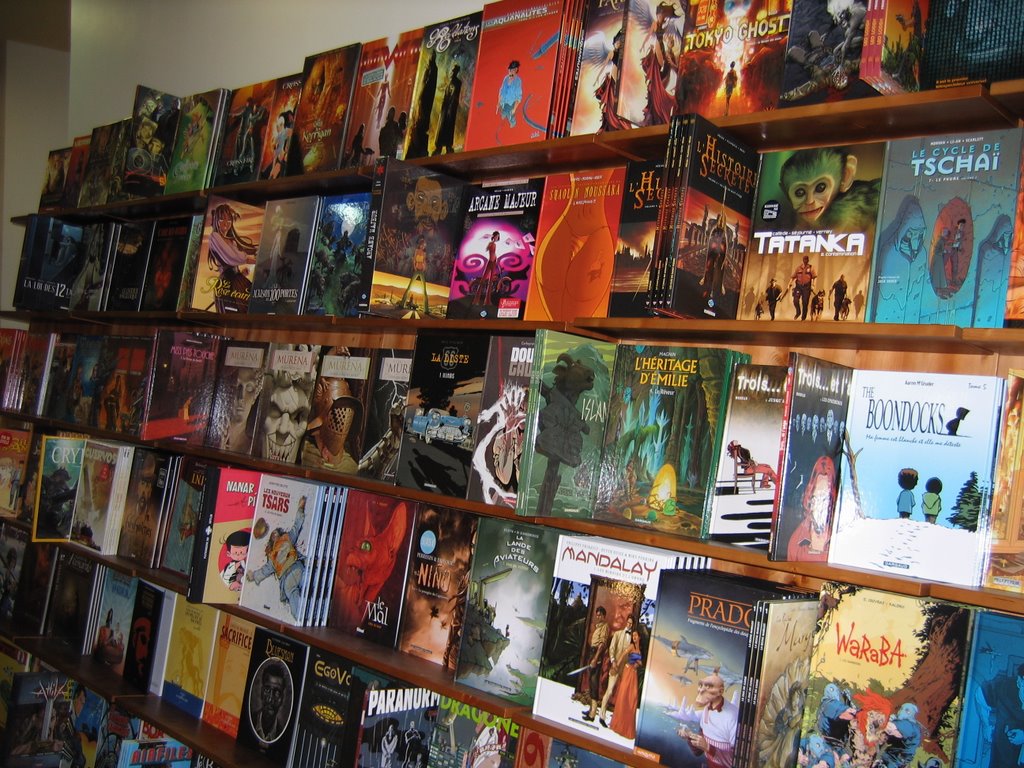
Bande Dessinée - French manga

Unknown to me for a long time, French not only loves Japanese manga, but are avid comic readers. In fact, France has a thriving comic industry, that I wouldn't be too surprise if they give the Japanese and US comic industry a run for their money.

Bande Dessinée is comic book in French. Unlike Japanese manga, they come in hard cover and A4 size, fully coloured. Price wise, they're definitely more expensive, each issue costing over 10 euros. However, unlike manga, they don't seem to run into ten over issues.


Step into a French comic shop and you'll be spoilt for choice. There is a comprehensive selection of creators, styles and genres, so much so that beginners would have difficulty in finding where to start.

The biggest problem perhaps is the language barrier. Most French comics are not translated into English and it's hard to find English editions, unfortunately. Maybe that's why many comic fans are unfamiliar with French comic. The most familiar French comic series to the English world could possibly be Asterix. Tin Tin is in French, albeit originating from neighbouring Belgium, which has a pretty robust comic industry as well, or so I heard.

So, it's a pity I'm still a far way to mastering French beyond bonjour and merci to enable me to read their comics.

Wednesday, August 23, 2006

Hiking for real

I've been an experienced "hiker" of concrete jungles, with real stamina for indulging in every female Singaporean's favourite pastime of shopping. Alas, the training I've received at Orchard Road is way insufficient in preparing me for my first hike with my bf's family.

It was an introductory hike for me, so it was expected to be easy. The plan was to hike at a plateau beside "La Meije", one of the highest mountain in the Rhone Alps. The idea was, after reaching the peak of the plateau (which is not very high by French standard), the road will be pretty flat and we will reach a lake. The whole adventure would last only around 3-4 hours.


The choice of hike is perfect, with a wonderful scenery to die for, which I almost did (in a way).

The reality: within short while, I was already having difficulty keeping with the rest of the group (which includes 1 grandmother and another young lady, both with an injured foot). :-P


Difficult it may be, all the sweat and pain has not gone to waste. La Meije is so beautiful that I couldn't resist taking photos after photos of it.

Tuesday, August 22, 2006

The day I jumped off the cliff


I don't mean suicide of course. Life is too beautiful to end it prematurely, especially when I'm enjoying almost every minute of it (especially when I'm on holidays).

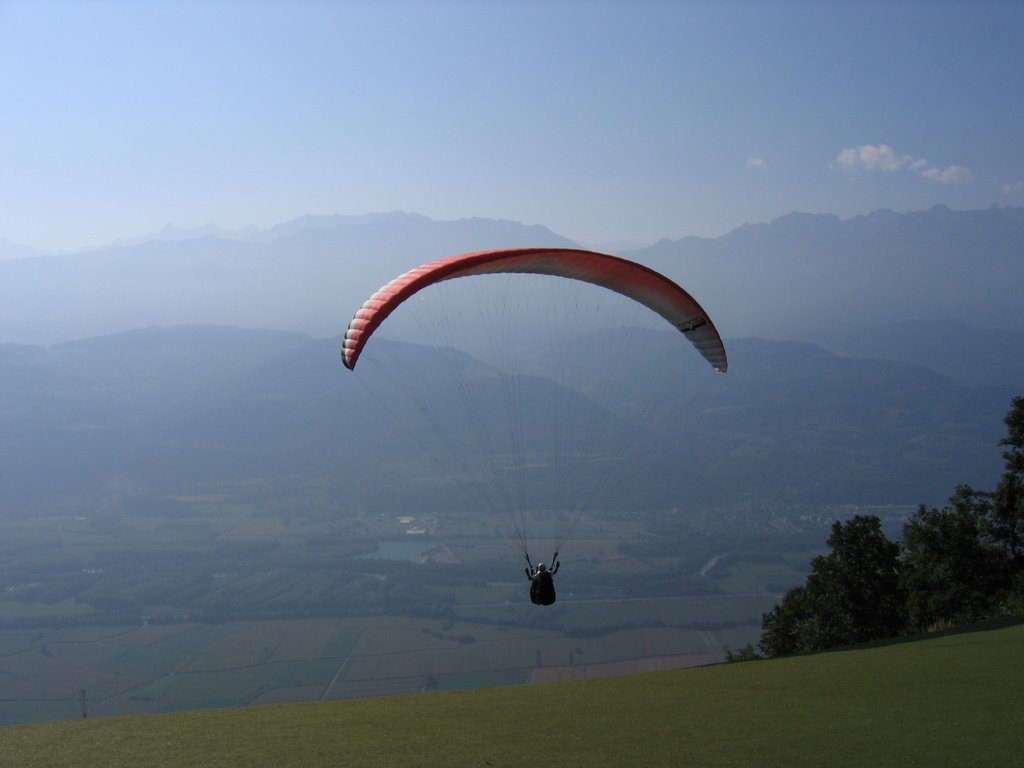
Well, I've made up my mind to jump from the cliff, literally, before going to France. Since I'm planning a visit to the Alps, and a country full of paragliders, tandem paragliding would be a good, easy and relaxing way to enjoy the mountain scenery.

Truth is, the height does freak me out initially. But there's always a first time and I've always harbour a secret desire to jump off a helicopter next by trying sky diving. So the plan is fixed and there's no turning back.

Standing at the edge of the cliff where I'm about to jump does make legs feel wobbly at first. It's no joke, considering that it's a steep drop of probably a thousand metres high.

The instructor was reassuring, telling me that I do not even have to sprint to catch the wind. True enough, after "walking" a few steps with him, we were lifted onto the sky within seconds, before reaching the edge of the cliff. Soon enough, my feet were already running in the air and I was comfortably seated in the parapente, securely strapped to the instructor. The village and valley came in full view underneath me, while we glide effortlessly along the cliff of the mountain for close to half an hour, aided by the stream of ascending wind blowing against the mountain edge.

"Wow, you've really got the most wonderful job", I exclaimed to my instructor, who couldn't agree less. Putting all fears of height behind me, I was soon busy clicking my camera away, totally awed by the thrill of being in the air.


The last few minutes of my flight adventure was to give me further new sensations when my instructor decided to let me experience freestyle paragliding. Without any warning, the world was suddenly spinning at full speed around me. Thankfully, the spinning didn't last long (but the effects of it did not wear off immediately).

Hmmm...I wouldn't mind taking up paragliding lessons next time.
 
visits